
Why Prediction Markets Are Becoming Gambling’s Most Contested Space?
For years, prediction markets sat at the edge of the gambling conversation. They were mostly treated as a niche product for political obsessives, crypto traders, or people who liked the look of a market screen more than a sportsbook slip. That changed fast. Over the past year and especially in recent months, prediction markets have moved into a larger and far more serious fight involving regulators, sportsbooks, tech platforms, media companies and state gambling authorities. The attention around Trump Media’s planned Truth Predict launch helped push the topic into mainstream political coverage, but the bigger shift is structural. This is no longer a curiosity. It is becoming a contested category with real commercial weight.
The reason the subject matters to a gambling audience is simple. Prediction markets do not just add another way to stake money on an outcome. They also change the language, the legal framing and the user experience. A standard sportsbook tells you what the line is, builds in its margin and takes your action. A prediction market sells contracts tied to events, prices them like probabilities and lets users think of themselves less as bettors and more as participants in a live information market. That difference in packaging is one reason the category has grown so quickly. It feels closer to news, trading and real-time reaction than to traditional betting, even when the economic risk looks very similar.
What Are Prediction Markets?
A fair starting point is the basic question, what is a prediction market? In simple terms, a prediction market lets users buy or sell a contract tied to whether a future event will happen. A “Yes” contract trading at 62 cents suggests the market thinks there is roughly a 62% chance of that outcome. If the event happens, the contract settles at $1. If it does not, it settles at zero.
It can sound technical at first, but the appeal is straightforward. Users are not just choosing sides. They are reacting to information, trading in and out of positions, and watching the price move as news changes the market’s view. The Commodity Futures Trading Commission's (CFTC) current rulemaking notice describes these contracts as information-aggregation tools whose prices reflect the collective beliefs of market participants.
Given the growing volume of prediction markets news over the past half year, the concept has expanded well beyond the US and is now gaining traction in markets like Britain. From a British perspective, much of the model will feel familiar to anyone who already knows betting exchanges. What is new is the rebranding, the cleaner interface and the attempt to make the exchange-style experience feel more intuitive to people who never thought of themselves as gamblers in the first place.
That shift in presentation is not cosmetic in a trivial sense. It changes who shows up. Someone who would never open a sportsbook account may still trade a contract on inflation, a presidential race, an Oscar result or an oil price threshold if it feels like part of following the news rather than joining a gambling site. That crossover matters because it broadens the customer base and muddies the old legal categories at the same time. The product can look like trading, behave like betting, and still be sold as information. Regulators are still trying to decide which of those three matters most.
To better understand the differences between prediction markets vs sports betting and betting exchanges, the table below breaks down how each model works, how pricing is determined, and which type of user each format is best suited for.
The Leaders of Predictions Markets: Kalshi and Polymarket
Kalshi and Polymarket still dominate the discussion, but they no longer define the category on their own. Based on our comparison and Google Trends analysis for Q1 2026, covering Robinhood, DraftKings, Kalshi, Polymarket, and Coinbase, Kalshi and Polymarket clearly lead in search interest, averaging 38 and 37, respectively, with Robinhood a distant third at 9. This broader list of prediction markets shows how the space is expanding beyond its early leaders.
Our research also shows strong regional preferences. Kalshi is most popular in states like Missouri, Wisconsin, Michigan, and Illinois, while Polymarket sees higher interest across parts of the Midwest and South, including Louisiana, Oklahoma, Iowa, Kansas, Maryland, and Virginia. Robinhood stands out as the only platform with notable traction in Alabama and is also favored in Tennessee. Meanwhile, DraftKings and Coinbase do not dominate specific regions but remain part of the broader mix in large markets like New York and California.
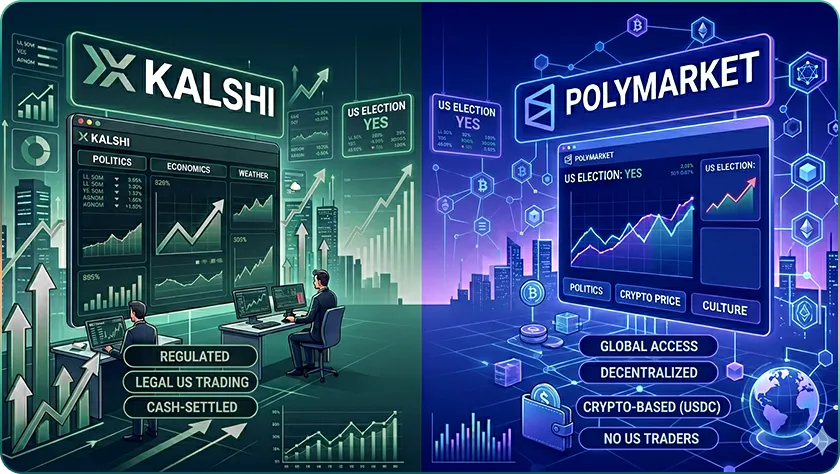
Kalshi has the strongest claim to legitimacy inside the U.S. regulatory frame because it operates as a CFTC-regulated exchange. That status has allowed it to present itself not as a rogue betting operator but as a lawful event-contract venue, even while states and critics argue that some of its sports markets cross directly into unlicensed gambling. Kalshi has also moved to tighten its controls. In March, the platform said it would block politicians and athletes from trading on their own campaigns or sports markets tied to their leagues, a clear sign that insider information risk is no longer a side issue.
Polymarket is different in tone and structure. It grew through crypto, political buzz and high-profile event markets, then moved closer to the center of the media conversation through distribution and data partnerships. Its 2025 deal with X matters because it shows where the market may be heading. This is not just about where people place a trade. It is about where probabilities appear while people are consuming live news and commentary. Polymarket and X planned integrated products combining market probabilities, X data and Grok analysis, pushing prediction pricing further into the daily information flow. That places Kalshi and Polymarket among what many now consider the best prediction markets, inside a wider fight over who gets to shape public expectations in real time.
Last October, Trump Media planned to launch prediction markets on Truth Social through a partnership with Crypto.com’s derivatives arm, called Truth Predict. Whether the product becomes dominant matters less than what the move signals. Social platforms now see prediction markets as a tool for engagement, monetization and political attention, not just as a betting product sitting elsewhere on the internet.
A newer wrinkle is the AI angle. Predictions markets fit AI products unusually well because they already turn messy news into a price signal. Once AI tools start explaining those moves, annotating price swings and surfacing sentiment shifts in real time, the product becomes more than a market. It becomes a live interpretive layer attached to the news cycle. That is one reason the sector has gained momentum so quickly. It matches the habits of users who do not just want to read the news. They want to react to it instantly and see what the crowd thinks the next development will be.
The Iran War: A Test for Prediction Market Platforms
The Iran war pushed the morality and integrity debate into a much harsher light. Prediction markets took large volumes of bets tied to the timing of U.S. attacks on Iran and to the removal of Ayatollah Ali Khamenei, with odds swinging hard as rumors spread and critics questioning both the legality and the ethics of such contracts. That is no longer just another current-events market. It creates the impression that war, assassination, regime change and geopolitical chaos can be packaged as tradable products for anyone quick enough to exploit the information flow.
This is also where prediction markets become something more than a betting story. In fast-moving geopolitical situations, they can act as a rough sentiment gauge before analysts, pollsters, or broadcasters have settled on a narrative. That speed is part of the appeal. It is also part of the danger. When price reacts to rumour, leaked information or social-media noise, the market can start amplifying uncertainty instead of clarifying it. Earlier this year, attention turned to privileged users making large gains on war-related markets, raising a more serious question: What did they know, and when did they know it? Once that question enters the public discussion, the credibility problem becomes much harder to manage.
The Iran angle also shows how far prediction markets betting has moved beyond its earlier niche. These platforms are no longer limited to sports, elections or entertainment stories with familiar rhythms and clear public interest. They now sit close to macroeconomics, military escalation, commodities and diplomatic strategy, areas where information moves faster, the consequences are heavier, and the line between market signal and public anxiety becomes much thinner. That creates a very different product from a Sunday accumulator or even a high-profile election special, and it draws in a very different type of user.
Legality and Oversight Are the Core Battleground
The legal story is no longer a murky sideshow. It is the core conflict. In February, the CFTC filed a Ninth Circuit brief asserting its exclusive jurisdiction over prediction markets and warning against state attempts to break up that authority. The move reinforced its position at the center of the evolving CFTC prediction markets framework. In March, the agency followed that stance with an advance notice of proposed rulemaking on prediction markets and a staff advisory reminding designated contract markets of their obligations, including the special issues raised by sports-related contracts. The federal message is clear. The CFTC sees these markets as part of its turf and wants to shape a coherent framework rather than leave the field to state-by-state intervention.
That does not mean the fight is settled. Far from it. States and gambling regulators have strong incentives to challenge products that look and feel like sports betting while bypassing state licensing systems, taxes, consumer safeguards and local integrity rules. The practical issue is not abstract. If a sports event contract can be listed on a federally regulated exchange and accessed in ways that resemble sportsbook behavior, state regulators will argue that their wagering framework is being undercut in plain view. Even supporters of prediction markets increasingly accept that sports is where the toughest legal questions now sit.
Oversight is also shifting from market access to market conduct. The CFTC’s February enforcement advisory highlighted cases involving the misuse of non-public information and fraud on prediction markets traded on KalshiEX. That matters because it shows regulators are moving past broad philosophical arguments and into concrete policing problems, surveillance, audit trails, market abuse and prohibited trading by people with direct influence over outcomes. In other words, prediction markets legality is no longer just a jurisdiction dispute. It is becoming an enforcement story.
Where Sportsbooks and Betting Exchanges Still Fit
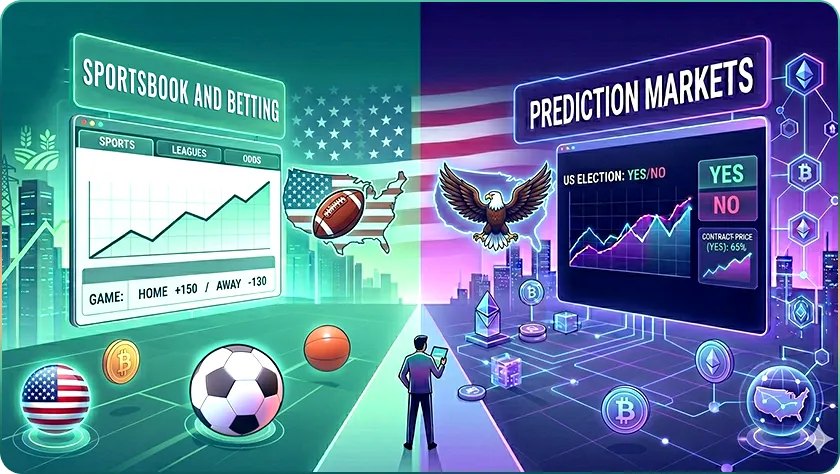
Sportsbooks still have the edge on familiarity and market depth. The bookmaker sets the odds, grades the result, builds in its margin and keeps the whole process simple for the user. For most bettors, it remains the easiest model to understand. A betting exchange works differently, matching users against each other and taking commission instead of acting as the house.
Prediction markets overlap with exchanges in structure, but they reach much further in subject matter and often feel closer to live news trading than conventional gambling. That wider scope is part of the appeal, especially when markets react quickly to politics, economics or breaking events. It also brings trade-offs. Liquidity can be thin, settlement wording matters more than many casual users expect, and the regulatory framework is still unsettled.
The Moral Question That Market Predictions Pose
There is no clean way to write about prediction markets without dealing with the moral argument. Supporters say a prediction market aggregates information, sharpens price discovery and sometimes outperforms polling or punditry. Critics say that is only part of the truth. When people can profit from war scares, deportations, political assassinations or sports outcomes in states that would not let them place the same bet through a licensed bookmaker, the distinction between financial innovation and dressed-up gambling starts to look very thin.
That criticism gets sharper when the user base includes younger adults who may not think of themselves as gambling at all. Prediction markets can be seen as a route around age limits and responsible-gambling structures built into state betting systems. Even where the legal argument remains disputed, the behavioral point is hard to dismiss. A product can carry the same loss-chasing risk, the same impulsive trading pattern and the same harm potential while presenting itself as something smarter and more respectable. That is why the morality debate has lasting force. It is not just about taste. It is about whether the framing of the product hides the level of risk.
Prediction Markets Expansion and What Comes Next
The next phase will not be defined by one court case or one platform. It will be defined by convergence. Prediction markets now sit where betting, social media, AI tools and regulatory conflict meet. Users are being trained to react to the news by taking a position, not just reading an update. Platforms want those positions because they keep people engaged. Regulators want rules because the market has already outgrown the old labels. Sportsbooks want clarity because they do not want a rival product expanding through a different legal door. That is why prediction markets vs sportsbooks is too narrow a frame on its own. The real question is whether prediction markets become a recognized branch of the gambling economy, a tightly supervised derivatives niche, or a hybrid that keeps fighting on both fronts.
FAQ
What Are Prediction Markets?
Prediction markets are platforms where users trade contracts based on the outcome of future events. These events can range from elections and economic indicators to sports and entertainment. Prices reflect the perceived probability of an outcome, making prediction markets a real-time indicator of collective expectations.
How Do Prediction Markets Work?
Users buy and sell contracts tied to specific outcomes, typically priced between $0 and $1. The price reflects the market’s estimate of probability. If the event occurs, the contract settles at $1; if not, it settles at $0. Traders can enter or exit positions before settlement, similar to financial markets.
What Are the Most Popular Prediction Markets?
The most prominent prediction markets include Kalshi and Polymarket, which currently lead in visibility and usage. Other platforms like Robinhood, DraftKings, FanDuel and Coinbase are increasingly entering the space or testing related products, contributing to a broader and more competitive ecosystem.
How Are Prediction Markets Taxed?
Tax treatment varies by jurisdiction, but in the U.S., profits from prediction markets are generally treated as taxable income. Depending on how the activity is classified, gains may be taxed as capital gains or ordinary income. Users are responsible for reporting winnings and keeping accurate records of their trades.
Are Prediction Markets Legal in the US?
Prediction markets operate in a complex legal environment in the U.S. Platforms like Kalshi are regulated by the CFTC and operate within federal rules, while others face restrictions or operate offshore. Ongoing regulatory debates continue to shape how these markets are classified and permitted across different states.





Review this Blog
Leave a Comment
User Comments
comments for Why Prediction Markets Are Becoming Gambling’s Most Contested Space?