How Sportsbook Apps Quietly Shape the Way You Bet

Expertise: Online casino, iGaming
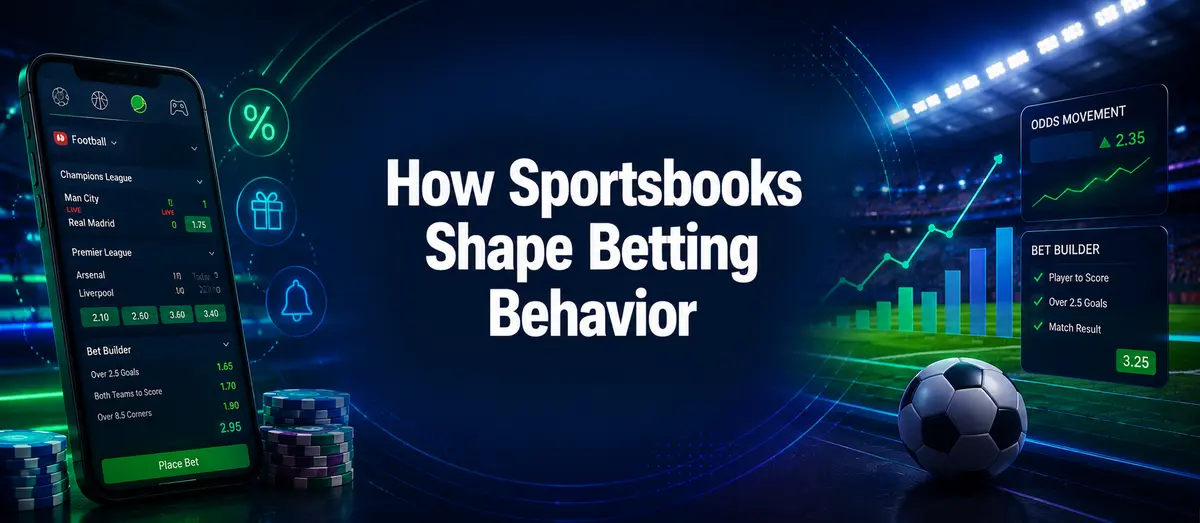
Walk into any conversation about modern sports betting, and someone will eventually mention the apps. Not the sports, not the odds in pure math terms, but the apps themselves. There’s a reason for that. The interface a bettor sees has been refined by behavioral teams, UX designers, and traders working from years of click data, and the resulting product nudges people toward specific actions far more often than most realize. A bettor placing what feels like a spontaneous parlay on a Tuesday night is usually responding to design choices made months earlier in a London or Las Vegas office.
This piece breaks down how sportsbooks influence the way people bet, where the line between service and steering gets blurry, and which operators are known inside the industry for which approaches.
What Is the Sharpest Sportsbook: Sharp vs Recreational Books Explained
The term “sharp sportsbook” gets thrown around loosely, so worth pinning down. A sharp book accepts large bets from professional bettors, moves its lines based on those bets, and posts prices closer to the true probability of an outcome. Inside the industry, sharpness is measured by which book’s prices the rest of the market moves toward. Books that consistently pull other operators in their direction earn higher weights in the line-shopping models that serious bettors actually use.
Pinnacle is the global reference point. The book operates on margins of 2 to 3 percent in major markets and welcomes winners rather than restricting them. It withdrew from the U.S. market in January 2007 in response to the Unlawful Internet Gambling Enforcement Act of 2006, and has not accepted U.S. customers since, though its posted lines are still used by American bettors as a benchmark for what efficient pricing looks like.
Betfair Exchange plays a similar role from a different angle. As a peer-to-peer exchange rather than a traditional sportsbook, prices on Betfair are set by bettors taking opposite sides of each market, which produces some of the tightest pricing in the world. Like Pinnacle, Betfair Exchange is not available to U.S. customers, but the model is worth understanding because it strips out the bookmaker’s margin almost entirely.
What is the sharpest sportsbook in the U.S.-licensed market? Circa Sports holds the sharp crown. Founded by Derek Stevens and headquartered out of downtown Las Vegas, the book takes NFL sides and totals at limits north of $20,000, compared to roughly $1,000 to $2,000 at most other Nevada outlets. Theoretical holds at Circa sit in the 3 to 4 percent range on core markets, a full point or two below the recreational standard. The defining characteristic is the posture toward winners. Circa publicly commits to taking action from anyone, including profitable players. The footprint is narrow by design, currently in Nevada, Colorado, Illinois, Iowa, Kentucky, and Missouri, with Missouri added in December 2025.
On the recreational side, the major U.S. apps operate with much higher margins, sometimes 6 to 8 percent on standard markets and well into double digits on parlays and player props. They make money by serving a high volume of casual players, and their treatment of winners reflects that. During a 2024 discussion on bettor limits led by the Massachusetts Gaming Commission, major operators acknowledged that some customers are restricted when their betting patterns suggest a long-term edge. BetMGM’s compliance representative said the book limits roughly 1 percent of Massachusetts customers, while FanDuel said its figure was lower.
The industry term is “stake factoring”, and operators defend it on the grounds that limiting a small minority of advantage players allows competitive prices for everyone else. Critics at the same hearing made the opposite point, that the players being limited are the ones who actually understand how to win. The Massachusetts hearing was one of several signs that U.S. regulators and municipalities are beginning to scrutinize how sportsbooks treat their customers, with Baltimore filing a lawsuit against FanDuel on related consumer-protection grounds.
For the bettor, the divide matters. The recreational book is engineered to be fun, fast, and visually rewarding. The sharp book is engineered to be accurate. These goals overlap less than most users realize.
How Major Sportsbooks Shape Bettor Habits
Each major operator has a personality, and that personality is mostly the product of deliberate design and marketing choices.
DraftKings
DraftKings came up through daily fantasy, and the DNA shows. The homepage prioritizes same-game parlays, boosted player props, and engagement features pulled straight from the DFS playbook. The Crown Rewards system keeps players moving between sportsbook, casino, and DFS by allowing points to be redeemed across all three. The bet mix tells the story clearly. Parlays grew from 32 percent of DraftKings wagers in 2020 to a majority of all bets placed by 2023. The CFO has described matching FanDuel’s bet mix as the “silver bullet” for closing the hold gap between the two operators, which says everything about the product’s commercial purpose.
FanDuel
FanDuel pioneered the same-game parlay in the U.S. market, importing the concept from its Flutter parent company after the feature succeeded in NBA betting overseas. The brand’s evolution from fantasy sports shaped how it approaches product design today. FanDuel has reported that roughly 90 percent of its active users have placed a same-game parlay.
In Illinois, the only state that publishes detailed bet-type breakdowns, parlays accounted for 71 percent of all bets placed through FanDuel in 2022, totaling close to a billion dollars in handle. Independent hold tracking suggests FanDuel’s pricing on MLB player props sets the market in many cases, with other books moving toward FanDuel rather than the reverse. That makes FanDuel a sharp book inside one specific market segment and a recreational book everywhere else.
bet365
bet365 operates in a dozen U.S. states and brings a different identity than the American-founded competitors. The product is built around in-play betting, with deeper live markets than most U.S. apps and a cleaner separation between pre-match and live interfaces. Globally, bet365 is one of the largest sportsbooks in the world, and the technology stack reflects that scale. In the U.S. specifically, the book operates with margins closer to the recreational standard, but the in-play depth gives experienced bettors more situational angles than the simpler app designs offer.
Other Major U.S. Books to Know
BetMGM leans heavily on its MGM Rewards casino tie-in, letting phone bettors earn comps redeemable at Vegas properties on the Strip. The sportsbook itself is competent rather than innovative, with main-market lines that tend to lag the sharper operators on both MLB and NBA pricing. The real engine sits in the cross-product hand-off from sportsbook to online casino.
Caesars rebuilt its sportsbook around the former William Hill U.S. operations, and the product reflects that lineage. The interface is more traditional and slightly heavier than FanDuel or DraftKings, which some bettors actually prefer. The Caesars Rewards tie-in is the main lever, and the comp earnings from phone betting can pay for real Vegas stays, like at BetMGM.
Fanatics Sportsbook is the newest major entrant worth watching. The product launched with a heavy push on merchandise integration, since the parent company sells team apparel at scale. Bettors earn FanCash that converts to gear, which sounds gimmicky until you see the redemption rate sits closer to dollar-for-dollar than typical loyalty point conversions across the rest of the industry.
Homepage Engineering
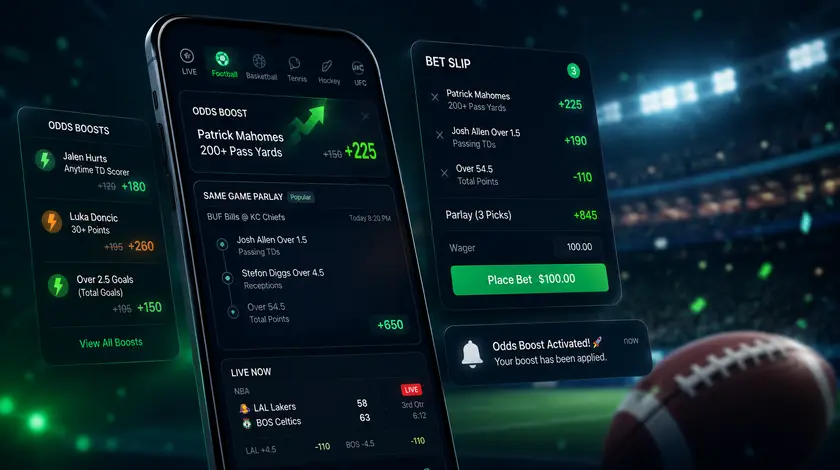
Open any major sportsbook on a Sunday morning during football season, and you are looking at a carefully sequenced piece of behavioral design. The top of the screen almost never shows the moneyline on the day’s biggest game in its simplest form. It shows a boosted parlay, a same-game suggestion, or a player prop with a price increase.
The reason is straightforward. Straight moneyline bets on football carry roughly a 4 to 5 percent hold for the book. A four-leg same-game parlay on the same matchup might carry 20 to 30 percent. Nevada’s historical sportsbook data, stretching back decades, shows an average 31 percent hold on parlay wagers across the regulated industry. That figure is not a projection. It is what the books have actually kept, over millions of tickets, across thirty-plus years.
Banner placement follows the same logic. The carousel rotates through promotions in an order that does not match the operator’s loss-leader generosity but the operator’s expected profit. A “no sweat bet” up to $1,000 looks like a generous gesture and converts to a strong retention metric. The fine print, which usually returns the stake as site credit with a 1x playthrough requirement, makes the offer cost the book far less than the headline number suggests.
Odds Boosts and Promotions
Odds boosts are the prettiest tool in the sportsbook design kit. A boost takes a standard parlay or player prop, shows the original odds with a strikethrough, and presents the new “boosted” price in green. The visual is calibrated to feel like a discount.
In reality, most boosts are still profitable for the book because they boost a parlay that started with heavy implied hold. A three-leg same-game parlay paying +600 might have a true price closer to +800, so the book’s implied probability is well above the actual probability. Boosting that ticket to +650 closes some of the gap, but rarely closes all of it. The bettor sees a deal, the book sees a marketing expense that still earns positive expected value across the book’s full action. Exceptions exist, mostly as customer acquisition tools in newly launched states, but bettors who consistently identify and play those exceptions tend to face account restrictions fairly quickly.
Push Notifications and Bet Builders
The phone notification is the most underrated tool in the sportsbook arsenal. A bettor with the app installed receives notifications calibrated to specific moments. A bet won, a player on a parlay started a game, a boost expires in 30 minutes, and a hometown team is about to kick off. Each one is a small invitation to open the app, and once open, the bettor is two taps from a new ticket. The timing is studied. Live betting alerts arrive in the third quarter when in-play volume peaks. Boost expiration alerts arrive close enough to game time that bettors have a limited window to evaluate, which pushes toward emotional decisions. Cashout offers arrive when a bet is trailing but recoverable.
The bet builder is the most consequential product innovation in modern sports betting. Five years ago, a bettor wanting to combine a moneyline, a total, and three player props had to figure out the correlation themselves. Now the app does it in seconds, calculates a price, and presents it as a single ticket.
The catch is that the price calculation is not transparent. The book uses a correlation model to discount the parlay where legs are positively related, then bakes in margin on top. The end result is a hold that is usually invisible to the bettor and often two to three times higher than the same legs would carry as separate single bets. A ticket with five correlated legs is typically paying somewhere between 20 and 40 percent in implied hold.
Jeffrey Benson, who runs sportsbook operations at Circa Sports, characterized the recreational industry’s parlay push in blunt terms when speaking to the Wall Street Journal, saying competitors were price-gouging customers and jamming parlays down their throats. Coming from inside the industry, the framing captures the divide cleanly. Sharp books rely on volume and tight pricing. Recreational books rely on steering casual users toward high-margin products.
The Psychological Layer
Sportsbooks borrow from casino design in ways most users would not consciously recognize. The confetti animation after a winning bet activates the same reward circuit as a slot machine win sound. The progress bar toward the next loyalty tier creates a sense of accumulated investment that makes account closure feel like a loss. The live-updating bet ticker turns watching the game into an extended scratch-card, with every play a potential trigger.
Cashout deserves a closer look. The offer is presented as a service to the bettor, a way to lock in a win or reduce a loss. The book offers it because the price is always weighted in the book’s favor relative to the live probability. A bettor who consistently accepts cashouts is consistently giving back expected value, often without realizing it. Loss aversion is also at work, since the bettor weighs the certainty of a smaller win more heavily than the uncertain larger one. Sportsbooks know this and use it.
Familiarity is another lever. Personalised home screens, suggested bets based on past behavior, and “your team is playing” prompts all reduce the friction between seeing the app and placing the bet. The fewer taps required, the more bets get placed. That is design as policy, not coincidence.
Why Bettors Should Notice the Design
None of this is hidden. The mechanics are public, the products are advertised openly, and bettors enter the relationship voluntarily. The reason to understand the design is that bettors who recognize the steering can choose when to follow it and when not to. A casual fan placing $20 on a Sunday parlay for entertainment is engaging with the product as intended, and there is nothing wrong with that. A bettor who wants to win money over time has to operate against the design, which usually means line shopping across multiple books, avoiding most parlays, ignoring most boosts, and using sharp books where available.
A sportsbook is not just a place to place bets. Its layout, features, and timing quietly shape what users notice, how quickly they act, and what kinds of bets they choose. Treating the app as a designed product rather than a neutral utility is the starting point for everything else.


