The Cost of Being You – How Algorithms Decide Your Price

Expertise: Online casino, iGaming
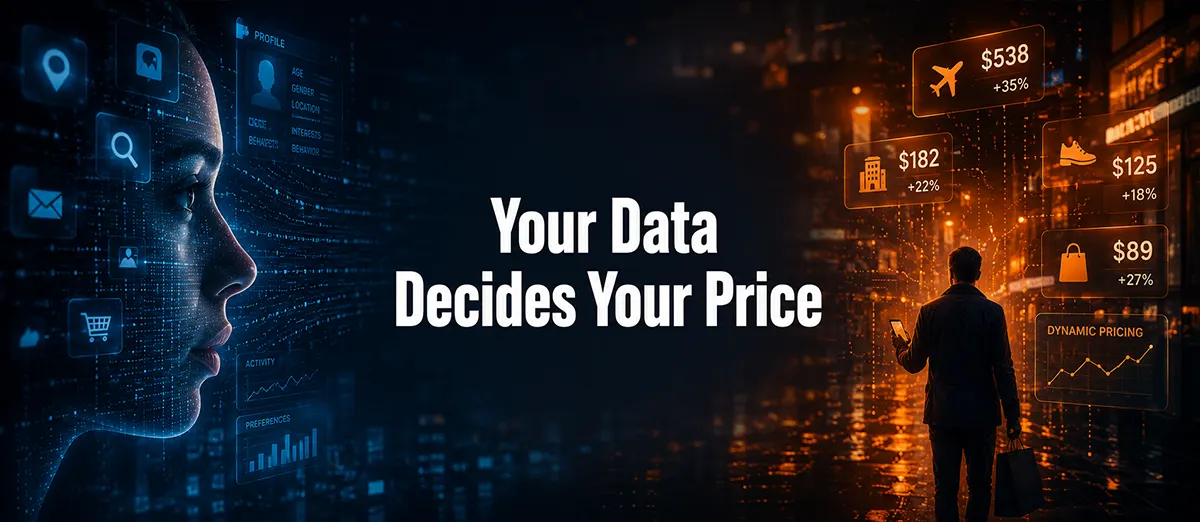
We’re long past the point where everyday actions don’t leave a trace. Every search, every scroll, every click feeds a vast, invisible engine – crafted to respond to our needs and to anticipate, nudge, and exploit our actions. Travel plans, product searches and essentials are affected by sophisticated systems designed not to serve, but to steer us toward higher costs. This is no longer convenience with a hidden fee; it’s manipulation that’s evolving faster than the public can track. Whether we like it or not, the days of browsing freely are over, and in this increasingly deceptive landscape, protection (or prevention) is no longer optional.
You check a flight, glance at a hotel, hesitate over a pair of shoes. When you return, the price has changed – not because seats sold out or inventory ran low, but because by returning to that site, you shifted the algorithm’s calculation. Welcome to the world of surveillance pricing, where your digital footprint, your habits, your device, and your timing quietly shape how much you pay.
Pricing is no longer universal or even predictable. Unlike traditional dynamic models, which adjust based on supply and demand, surveillance pricing is built on personal profiling. It doesn’t just care what you want – it cares who it thinks you are, and more importantly, what you’re likely to pay. That assumption becomes tailored pricing and is often invisible to people being charged.
Most consumers have come to accept the fluidity of airline fares, hotel rates, or ride-share surges, but there’s a meaningful distinction between variable pricing and targeted pricing. The former responds to external conditions; the latter responds to you, and the deeper the system’s insight, the more precisely it can extract value, without you realizing it’s happening. The travel and hospitality sectors have been caught playing the same game, with hotels and airlines rigging prices in plain sight through software that quietly coordinates what you pay.
From Retail Quirk to Everyday Practice
A decade ago, some of the earliest signs of this practice surfaced in retail. Staples’ website was caught adjusting prices depending on a visitor’s ZIP code so those near brick-and-mortar competitors received better deals. Wealthier neighborhoods, where price sensitivity was presumed lower, were served with higher rates. Orbitz, meanwhile, was found to be showing Mac users more expensive hotel options than those on Windows machines! Amazon has long denied profiling customers in this way, but rumors persist, and anecdotal evidence continues to surface. Prices fluctuate with suspicious accuracy around browsing history, Prime membership, or even shopping cart behavior – where the Amazon Gods never announce their reasoning; they simply decide.
What makes these systems so effective, and so difficult to challenge, is their subtlety. They don’t declare, “You’re being charged more because you hesitated”. They don’t warn you that lingering too long over a product may trigger a price bump. Instead, they mask these forms of manipulation as ‘personalization’ or a ‘tailored experience’, a ‘curated offer’, perhaps even a ‘reward’ for your loyalty.
In one widely cited case, Uber’s chief economist remarked that users with low phone battery were more likely to accept surge pricing – though the company denied ever using battery life as a pricing factor. Later, independent testers in Delhi claimed to find differences in fare offers under supposedly identical conditions, depending on whether the phone was running Android or iOS, and depending on battery level. I consider that experiment anecdotal at best, but given my blend of cynicism and paranoia, I assume that any signal that might squeeze more profit is fair game for modern corporations.
Whether or not these companies explicitly code such behaviors, anything that signals urgency, affluence, or reduced decision-making capacity might be used as a lever and surveillance pricing extends far beyond consumer tech.
Insurance companies have employed usage-based models that track not only how you drive, but when, where, and even which apps you use during your journey. What began as telematics – speed, braking, mileage – has evolved into behavioral surveillance, where data points far removed from actual risk now dictate how much you’re charged. A distracted driver, or a night-shift worker driving at odd hours, might be penalized not for poor driving, but for fitting a more expensive profile.
Food delivery services quietly adjust fees based on location, time of day, or even inferred income. Input a ZIP code from a less affluent area, and the fee might fall; change to a wealthier neighborhood, and it may climb. Grocery apps and e-commerce platforms have begun experimenting with region-sensitive pricing, where the number you type into your shipping field can influence the price tag before checkout. Even those cautious enough to log out and browse incognito often find themselves priced according to personal data already collected.
When the Same Logic Reaches Online Gambling
The same logic plays out even more intimately in the world of online gambling.
Gaming platforms track everything – bet sizes, timing, hesitation, deposit patterns, even when a user is most likely to chase losses. It’s well known that high-frequency players receive tailored offers – bonuses, free spins, better odds – but that tailoring may not always be in the player’s best interest. I’ve seen enough behind the curtain to suspect that what looks like a reward may, in fact, be bait.
There’s no hard proof that odds are adjusted dynamically based on fatigue or desperation, but when behavior is monitored this closely, it’s hard not to imagine algorithms testing how far they can push us, so limits might stretch just as a player starts to spiral. Promotions might appear when they’re most vulnerable. And whether or not it’s coded that way, the effect is the same: the longer you play, the more the system knows, and the better it gets at keeping you right where it wants you.
It’s the same psychology that keeps players returning whether the lever is a casino floor or a betting app, an influence that works precisely because you don’t notice it. Any such ‘experience tailoring’ would be buried so deeply in proprietary software that regulatory scrutiny becomes almost impossible. These ploys don’t shout; they nudge, and the dangers related to gambling addiction could be enormous.
What makes surveillance pricing particularly dangerous is its opacity.
There is no warning, no audit trail and no price comparison between users. The lack of transparency creates the illusion of fairness – even when two people sit side by side, browsing the same site, possibly through the same VPN, and still receive different prices for the same product. Victims (you and I) rarely suspect these techniques, and currently, there’s no clear path to prove it.
Most regulations still treat pricing as a function of markets, not of identity. The idea that a company might charge you more because of your browsing habits or your phone model simply doesn’t fit into current definitions of discrimination or unfair practice. Even in Europe, where digital rights are more robust, enforcement is patchy, and most companies rely on the murky protections of “personalization” and “relevance” to justify their tactics.
Who Pays the Price
The people most affected by surveillance pricing are often the least equipped to shield themselves from it. Affluent users with technical knowledge can mask their digital identities – using VPNs, alternate devices, private browsers – while those browsing from older phones, shared computers, or public Wi-Fi remain exposed, leaving a trail of data that becomes the basis for higher costs: a student booking emergency travel; a parent ordering food after work; an older adult trying to navigate a medical platform. These aren’t luxury consumers; in the labyrinth of ‘tailored pricing’, they become victims of unfair practice.
Naturally, politicians have been slow to address this issue, allowing big businesses to continue pushing boundaries in the hope that any legislation will take years to implement, by which time their methods will have become even more sophisticated. Meanwhile, moronic parliamentarians compel users to constantly ‘accept cookies’ with no real alternative, while trying to ban VPNs, while corporations employ an army of programmers and psychologists happily exploring ways to further manipulate our online experience.
Surveillance pricing isn’t a curiosity of the algorithmic age. It’s a shift in power that quietly redefines who pays how much, and why. Left unchecked, it deepens inequality, rewards exploitation, and erodes the last remnants of shared economic reality. Put simply, it’s absolutely a scam being played on a grand scale, and now that billions are being made, it becomes increasingly difficult to return to a fairer pricing model.
Pricing reform begins by asking, every time we open a browser, not what the price is, but what it means.


