Madonna, Shakira, BTS, and FIFA’s Biggest American Gamble Yet

Expertise: Online casino, iGaming

When Shakira walked onto the Hard Rock Stadium pitch at the 2024 Copa America final, metallic silver under the lights and a wall of dancers behind her, she turned a football interval into a concert. Two summers later, that instinct gets its largest test. On July 19, 2026, at MetLife Stadium in New Jersey, Shakira will share the bill with Madonna and BTS for the World Cup final halftime show into one of the tournament’s biggest cultural talking points. Coldplay’s Chris Martin will curate the production, which will be staged with Global Citizen.
The United States flirted with World Cup spectacle once before. Back in 1994, when Whitney Houston sang at the closing ceremony of the Rose Bowl final. FIFA stopped short of a Super Bowl-style intermission then, and the idea went quiet for a long time. More than thirty years later, the FIFA World Cup final 2026 looks like the moment FIFA fully commits to the idea, with a bill built to hold global attention way beyond the match itself.
The Long Road to a World Cup Halftime Show
Fans raised on European football have always read the interval as a tactical pause, fifteen minutes for water and a tweak to the shape, never a stage. American audiences come at it from a different angle. They are used to the Super Bowl, where the halftime show often becomes part of the main event and sometimes generates more headlines than the game itself. That cultural gap is why searches like “do soccer games have halftime” still make sense in the US. Football has had a halftime interval for more than a century. What it has not had, until now, is a reason to fill that break with Madonna.
FIFA started closing that gap in 2025, when the expanded Club World Cup ran on American soil. The FIFA Club World Cup halftime show at the final paired J Balvin, Doja Cat, and Tems, with a surprise Coldplay walk-on, and ran a little past 24 minutes. It worked. The crowd stayed, the broadcast numbers held, and the format proved it could travel. The tournament itself was also a test of whether the Club World Cup could make soccer bigger in the US.
Shakira has been the through-line between the two eras. “Waka Waka” soundtracked South Africa in 2010. Her Copa America headliner in 2024 showed the halftime format could carry a championship night on its own. By the time FIFA needed a recognizable face to anchor the FIFA final halftime show, she had been rehearsing the role for fifteen years.
Five Continents on One Stage
The lineup makes sense the longer you look at it. Shakira gives FIFA a direct line into Latin America, Madonna brings the kind of legacy pop name that makes the night feel closer to a Super Bowl broadcast, and BTS adds a global fanbase that can move online attention in minutes. Chris Martin covers Europe from the production booth, no stage time required.
Africa is part of the plan too. Shakira’s tournament song “Dai Dai” features Nigerian artist Burna Boy, and Uganda’s Ghetto Kids will dance beside her at MetLife. That booking has a story behind it. The group was founded in 2014 by Dauda Kavuma with children from the Katwe slums of Kampala. Their rise has taken them from French Montana’s “Unforgettable” video to the 2022 Qatar World Cup festivities and Britain’s Got Talent. Shakira confirmed their role in an Instagram clip on May 20, asking fans to keep posting their own “Dai Dai” routines.
The whole tournament follows a similar pattern. The opening ceremony on June 12 at SoFi Stadium in Los Angeles features Rema and Tyla, two more African acts, so 2026 runs from an African opening to an African-threaded final. For a competition long accused of treating Africa as set dressing, that is a deliberate correction.
Why Broadcasters May Treat the Show Differently
Not every broadcaster appears eager to embrace the spectacle. Reports in the UK suggest that the BBC plans to focus on traditional halftime analysis rather than carry the halftime show FIFA World Cup performance in full on its main broadcast, with viewers likely directed to digital platforms if they want to watch the music. ITV is reportedly considering a similar approach. With pundits including Alan Shearer, Wayne Rooney, Cesar Azpilicueta and Olivier Giroud already part of the World Cup coverage team, the preference seems to be for tactical discussion rather than a concert in the middle of the final.
The contrast goes beyond Britain. In the United States, the show is expected to be treated as a major part of the broadcast, with Fox and Telemundo both experienced in presenting large-scale sports entertainment. In parts of Latin America, the performance could become almost as important as the match itself. The same halftime break may be viewed as a concert in one country and a football debate in another, reflecting very different ideas about what a World Cup final should look like.
Another unanswered question is how long the show will actually last. Reports have suggested anything from 11 to 25 minutes, while the Club World Cup final halftime show ran for just over 24 minutes. That uncertainty alone is enough to create interest among bookmakers, who have never had a World Cup final halftime show to price before.
Global Citizen, Chris Martin, and the $100 Million Education Pitch
The performance is also built around a fundraising pitch. Royalties from “Dai Dai” and revenue connected to the FIFA World Cup halftime show will support the FIFA Global Citizen Education Fund, which is aiming to raise more than $100 million by the end of the tournament for children’s education and access to football. That is where the Ghetto Kids booking starts to matter beyond the visual moment. A dance group formed with children from Kampala’s Katwe area performing on one of sport’s biggest stages gives the fund a human face rather than leaving it as a number in a press release.
Chris Martin’s role is interesting because he is curating rather than fronting the show. Coldplay’s surprise appearance at the Club World Cup final proved that they could have taken the spotlight if FIFA wanted that. Instead, Coldplay is helping shape a lineup built around different regions and audiences. Global Citizen brings the organizing structure, FIFA brings the stage, and the artists bring the reach. The charity element feels stronger because it is tied into the production from the start, not added afterward as a soft PR line.
The Betting Angle: When Halftime Shows Become Markets
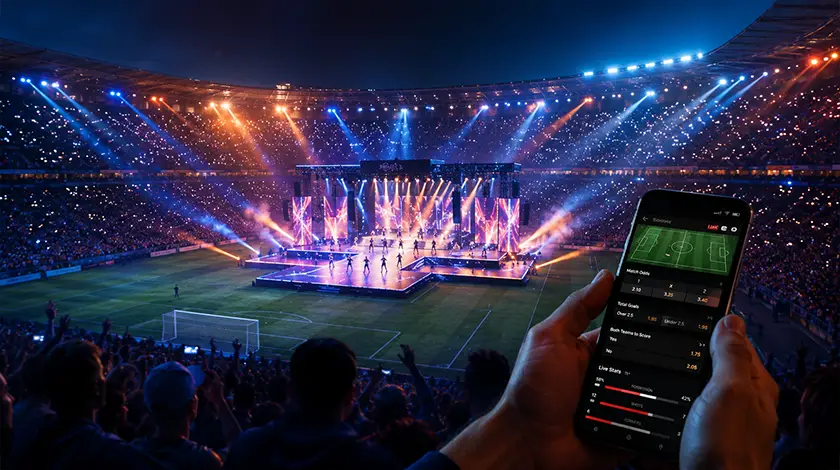
Halftime shows have quietly become a betting category of their own in the United States. Props on song order, surprise guests, set length, wardrobe color and even specific lyrics have run at several US sportsbooks for years now, with what is offered shifting state by state. The FIFA World Cup halftime show is the first time that machinery meets a global football final, and the setup favors it. MetLife hosted Super Bowl XLVIII in 2014, so the New Jersey books already know how to price a Super Bowl-style halftime card.
The likely markets write themselves. Does Burna Boy appear during “Dai Dai”? Does BTS open or close? Does the set run past twenty minutes? Does Chris Martin step out from behind the curtain?
Each is a clean yes-or-no that slots into the template books already use. That is where the sportsbook app becomes part of the story. A halftime prop is not only a market. It is also a prompt placed at exactly the moment casual viewers are already looking at their phones, which is how sportsbook apps shape the way you bet around major events. Operators across regulated European and Latin American markets are expected to follow, with what they can post shaped by local rules and whatever FIFA-adjacent deals are in place.
For sportsbooks, the value is not only in the halftime props themselves. Halftime props are small compared to the match. What they do is turn a casual viewer into an account. Someone who tuned in for Madonna and never bet on soccer in their life puts five dollars on whether BTS performs first, and that slip becomes a customer record, a marketing contact, the long-tail value the books are actually after.
Why July 19 Could Become a Landmark Betting Event
Interest around the final is already being framed in historic terms, and FIFA will be chasing a global audience. Reporting puts global viewership for the match above four billion, which would place it among the most-watched broadcasts on record. The kickoff lands in peak US betting hours, on a summer Sunday, with no competing American sports on the calendar. The halftime show works as a multiplier rather than a distraction, pulling in viewers who would never have switched on for the football alone.
The betting handle could climb further if Lionel Messi or Cristiano Ronaldo reaches the final. Both are widely expected to play their last World Cup in 2026, and either one walking out for the closing match would turn the interval into the soundtrack to the most-watched farewell in sport. Betting volume around legacy moments tends to beat the forecasts, and the books know it. For US operators, the final has long been the on-ramp where casual American bettors first take soccer seriously, and the halftime show widens that ramp.
FIFA’s Bigger American Bet
FIFA has been fairly open about the direction of travel. The FIFA World Cup 2026 is the federation’s biggest push into the American market in a generation, and the halftime show is its loudest signal. Gianni Infantino has spent years building political and commercial ties in the US, including repeated appearances alongside Donald Trump, and July 19 is where that groundwork either converts or falls flat.
The risk is not money. The production will draw eyes no matter what. The risk is taste. Get it wrong, and it reads as a Super Bowl knockoff stapled to a football match, and the global audience rolls its eyes. Get it right, with five continents on the bill and a funded cause behind it, and it becomes the blueprint for every final that follows. The casting suggests FIFA understands the difference. Three headliners from three continents, a Ugandan dance crew, an Afrobeats collaborator, and a Coldplay frontman running the board is not an accident.
For the four billion expected to watch, and for the bettors and broadcasters circling the night, July 19 will show whether the World Cup final can absorb a Super Bowl-style halftime show without losing its own identity. What happens next will depend on whether the show feels like part of the final, or like something placed on top of it.


